Ice Coverage Figure Skating: How to Build a Longer, More Effortless Glide
Ice coverage in figure skating means the distance you travel per stroke through a clean edge, a complete push, and smooth weight transfer — not how fast your feet are moving. Effortless glide comes from finishing each stroke fully and trusting the edge, not from skating harder or faster. Once a skater understands this, everything else on the ice starts to change.When a skater steps onto the ice with me for the first time, I’m not watching their jumps or their spins. I’m watching how far they travel on one push. That single detail tells me almost everything about where we need to start.Here’s the good news: ice coverage is technique, not talent. I’ve spent years building skaters from their very first strokes through competitive levels, and the skaters who cover the most ice aren’t the ones who were ‘born with it.’ They’re the ones who learned to finish a stroke before starting the next one. In this post, I’ll walk through the technique, the drills I actually use at the rink, and what effortless skating looks like at each stage of training.
What Does ‘Ice Coverage’ Actually Mean in Figure Skating?
Ice coverage is the amount of ground a skater travels per stroke, per edge, per transition — it’s about distance and quality, not raw speed. A skater taking big, controlled strokes down the ice is covering more ground than one taking ten frantic little steps, even if the second skater looks busier.This is the part parents and younger skaters mix up most. Skating fast and skating with coverage are not the same thing. I’ve had skaters who look like they’re working hard — legs pumping, arms swinging — and barely travel anywhere. I’ve also had skaters who look almost lazy, gliding on one strong edge, who cover twice the ice with half the effort.U.S. Figure Skating’s skills standards actually tie this together directly. Flow, edge quality, power, and energy are judged as connected qualities, not separate boxes to check. That’s because they *are* connected. You can’t have real flow without clean edges, and you can’t have power without a push that actually goes somewhere. The whole package is trainable — which is the part I want every skater and skating parent to hear clearly.
What Makes Skating Look Effortless?
Effortless skating isn’t about using less effort — it’s about using effort efficiently. The mechanics behind it are specific and learnable:
- The blade sits on a controlled edge, not skidding or scraping
- The push drives into the ice along the curve of the edge, not out to the side
- Weight transfers smoothly from foot to foot, with no hitch or jolt
- The upper body stays organized and quiet while the legs do the actual work
- Each stroke flows directly into the next instead of stopping and restarting
Here’s the myth I bust constantly: slow does not mean gliding well. A flat blade moving slowly covers almost no ice — it’s just drifting. True glide is controlled speed on a committed edge. Those look similar from the stands but feel completely different under a skater’s feet.
The Core Technique Behind Ice Coverage
Blade Mechanics and Edge Quality
Everything starts with the eight basic edges — inside and outside, forward and backward, on both feet. These aren’t a beginner formality to get through quickly. They’re the foundation every stroke, turn, and transition is built on for the rest of a skater’s career.When I watch a skater’s edges, I’m checking:
- Is the tracing clearly curved, not a flat line?
- Is the edge consistent from the start of the push to the end of the glide?
- Is the blade quiet — no scraping sound as it moves?
- Is the skater’s weight centered directly over the skating foot?
- Does the free leg support the line of the edge instead of fighting against it?
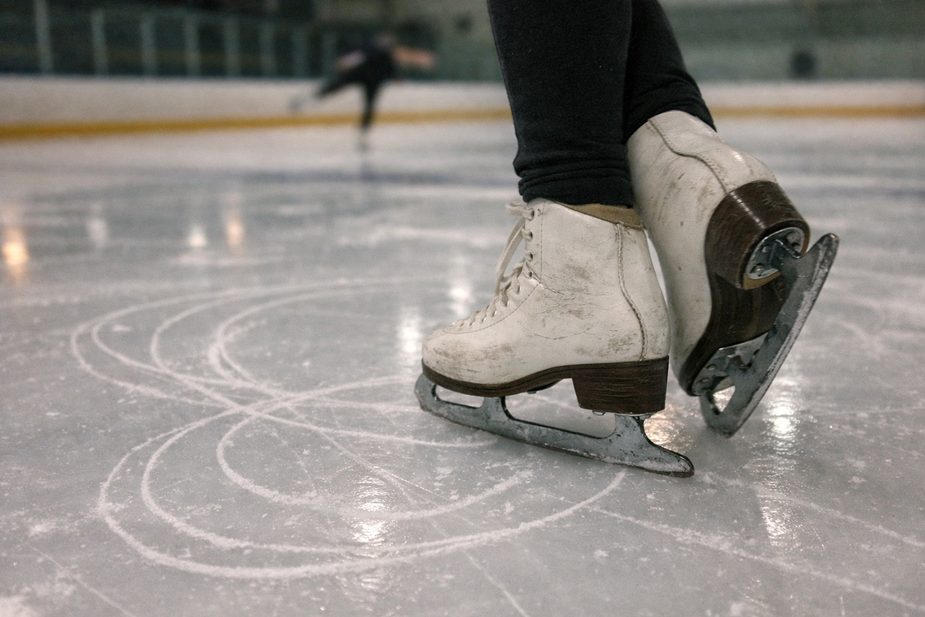
The most common mistake I see is a zigzag tracing — the skater cuts the edge off early and jerks into the next stroke instead of letting one edge flow into the next. It looks rushed because it is rushed.The fix is almost boringly simple: go slow. Practice large circles on one foot at low speed, focusing only on the quality of the tracing left behind on the ice. Don’t add speed until the curve is clean every single time. Speed will hide a messy edge; slowness exposes it.
Knee Bend and Extension Timing
Every stroke has a sequence, and skaters who struggle with coverage are almost always skipping a step in it without realizing:
- Set the skating position
- Bend into the edge
- Push through the ice
- Extend fully along the curve
- Transfer weight smoothly to the new foot
- Repeat on the opposite side
Two mistakes show up constantly. First, standing up too early — before the push finishes — which kills the power before it’s fully delivered. Second, the opposite problem: staying bent the whole time and never extending, so the push never actually completes.My go-to cue at the boards is simple: ‘Finish the push before you think about the next one.’ Skaters who are already thinking ahead to stroke number two are usually cutting stroke number one short.
Posture That Supports Glide
Posture isn’t decoration — it’s structural. Head and chest stay lifted, with no collapsing at the waist. Shoulders and hips move together along the curve instead of twisting independently of each other.The balance shift should come from the center of the body outward, not from leaning the shoulders in the direction you want to go. Good posture is active, not stiff. The torso stays quiet and organized while the legs handle all the bending and pushing underneath it.
How to Get a More Powerful, Efficient Push
A powerful push directs force along the curve of the edge — not out to the side, and not straight up. A big spray of ice when you push doesn’t mean more distance; it often means energy is leaking sideways instead of going into travel. A tall, pretty-looking extension with no direction behind it doesn’t produce real momentum either.An effective push checks these boxes:
- Starts from a stable, controlled skating foot
- Follows the curve of the edge, not a straight line
- Finishes in a full extension
- Lands the new foot quietly, without a stomp
- Keeps hips and shoulders aligned with the direction of travel
I tell skaters constantly: the biggest-looking push is not automatically the best push. The best push is the one that produces real distance while keeping the skater balanced and in control.
Weight Transfer and Rhythm Between Feet
Timing between feet makes or breaks coverage. Transfer too late, and the stroke dies before it should. Transfer too early, and the push gets cut short before it delivers its full value.Backward crossovers are a great illustration of this rhythm: push, cross, hold, together. That ‘hold’ moment matters — it’s where the travel actually happens. The same principle applies to stroking in general: push, travel, *then* begin the next action. Skip the ‘travel’ part and you’re just stepping, not skating.
Why Do Skaters Lose Ice Coverage? (Common Mistakes and Fixes)
These are the habits I see most often at the rink, and the fixes that actually work:
| Mistake | Fix |
|---|---|
| Taking many small steps instead of full strokes | Count strokes deliberately and focus on finishing each one |
| Pushing from a flat blade | Return to edge-only drills before adding any speed |
| Switching feet before the extension finishes | Use the cue ‘hold the edge’ before transferring weight |
| Standing too tall during the push | Slow the bend-push-extend sequence down and exaggerate it |
| Bending at the waist instead of the knees | Check posture on video or in a mirror |
| Looking down at the ice | Practice with eyes up, using peripheral vision for the ice |
| Rigid free leg | Drill one-foot glides, focusing only on free leg line |
| Rushing turns and transitions | Treat every transition as a continuation, not a stop |
| Overusing arms to force direction | Keep arms quiet — let the blade and legs create the curve |
If you only fix one thing this season, fix the small-steps habit. It’s the single biggest coverage killer I see across every age group.
A Step-by-Step Practice Progression for Better Ice Coverage
Step 1 — Get an Honest Baseline
Have the skater do a straight-line stroking pattern or a large circle. Count how many strokes it takes to cross a known distance. Watch whether speed drops sharply after each push, whether the tracings are curved or zigzagged, and whether the free foot returns cleanly each time.Film it from the side and from the front. Skaters are often shocked at the gap between how hard they felt they were working and how little ground they actually covered.
Step 2 — Push-and-Glide Drill
One controlled stroke, then hold the resulting glide without adding another push. Let the speed decrease naturally on its own. Repeat on the opposite foot.This drill is revealing because there’s nothing to hide behind. If the push was weak, the glide dies immediately. If the push was strong, the glide carries for a real distance.
Step 3 — Large Circles on Edges
Skate large forward and backward circles focusing on a consistent curve, a quiet blade, a stable upper body, a free leg that supports the direction of travel, and a smooth change from foot to foot.Bigger circles force sustained edge commitment. Small, tight circles let skaters cheat with quick, shallow curves that don’t build real edge strength.
Step 4 — Progressive Stroking
Once the basics hold up, start asking for more distance per stroke without losing edge quality. In practice, I use cues like:
- ‘Finish the push’
- ‘Hold the edge’
- ‘Travel before the next stroke’
- ‘Quiet feet’
- ‘Keep the curve’
- ‘Let the glide carry you’
Step 5 — Apply It to Transitions
Once basic stroking is solid, layer in three-turns, mohawks, crossovers, and step sequences. The goal is to preserve travel *through* the turn, rather than treating the turn as a stop-and-restart moment. This is where coverage either survives or falls apart under real program conditions.
How to Practice Quality Glide, Not Just Speed
Speed can mask poor technique. Frequent small steps, leaning on the upper body for momentum, or a shallow flat edge can all look fast without producing real ice coverage.Here’s how I check for the real thing:
- Covers more ice with fewer unnecessary actions
- Edge stays recognizable from start to finish of the stroke
- Skater can intentionally speed up or slow down on command
- Quality is the same on both feet and in both directions
- Glide survives a transition without breaking down
- Pattern holds up even when the rhythm changes
A drill I use often: skate the exact same stroking pattern at slow, medium, and fast speeds. This trains edge-based speed control instead of just chasing a top speed, which is a much more useful skill in an actual program.
Ice Coverage at Different Skating Levels
Developmental Skaters (Early Years)
At this stage, priorities are basic forward and backward stroking, inside and outside edges, controlled one-foot and two-foot glides, simple circles, a stable skating position, and — most importantly — finishing one stroke before starting the next.This is where I spend the most careful attention as a coach, because habits formed here follow a skater for years. When I’m working with young skaters building their very first real edges, I’m teaching them to feel the push and the glide as two distinct parts of the same motion, grounded in the Learn to Skate USA foundational progression. Get this right early, and everything later gets easier.
Intermediate Skaters
At the intermediate level, the focus shifts to edge depth and consistency, push direction, crossover rhythm, entry and exit speed on turns, and maintaining coverage through full step sequences — with equal quality on both sides, not just the stronger one.Counting strokes across a known distance is a useful feedback tool here, but it’s always secondary to edge quality. A skater who takes fewer strokes but on sloppy edges hasn’t actually solved anything.
Competitive Skaters
At the competitive level, the question changes. It’s no longer ‘how far did you travel on that one stroke’ — it’s ‘did you keep traveling with purpose through the entire program.’ Maintaining flow and coverage while executing turns, transitions, and elements like jumps under program pressure is a skill built over seasons of training, not something a skater discovers on competition day.My own background shapes how I build this progression from a skater’s very first steps through junior competitive levels — I was named PSA Coach of the Year in 2019, recognition that reflects years of developmental coaching work. I also coached Alysa Liu during her early childhood and junior years, and that experience taught me a lot about how foundational edge work in those early seasons pays off as a skater moves up through the levels. You can read more about my coaching background and how I approach training skaters from their first lesson onward.
How Ice Coverage and Skating Flow Shape Program Quality
Judges evaluate skating skills through flow, edges, power, and energy — and ice coverage is foundational to every one of those categories. A skater who covers ice well gives a program a completely different texture than one who doesn’t.Good coverage improves a program in concrete ways:
- Gives the choreographer more ice to actually use
- Makes transitions look intentional instead of necessary
- Creates real contrast between sustained glides and quick footwork
- Lets musical phrasing carry across the full sheet of ice
- Helps the skater arrive at elements under control, not rushed
- Gives the whole program a clearer sense of direction
There’s a confidence piece here too. A skater who trusts their edge doesn’t feel the need to rush. That composure reads immediately to judges and audiences — it looks like presence, not just technique.
Frequently Asked Questions
How long does it take to improve ice coverage?It depends on the skater’s starting habits, current edge control, and how consistently they practice. Some changes show up quickly once a skater simply stops cutting the glide short — but lasting improvement takes consistent work across both directions and both feet, and it needs to hold up once skating skills get applied inside a full program.Can I have good ice coverage and good speed control?Yes, and they actually support each other. Strong edges give a skater more control, not less. Practice coverage at multiple speeds — slow, medium, fast — instead of treating coverage and top speed as the same thing.What’s the difference between gliding and just going slow?Gliding is controlled travel on a deliberate, committed edge or curve. Going slow can simply mean low momentum on a flat, unstable blade. The giveaway is the tracing left on the ice — a true glide leaves a clear, consistent curve behind it.Does ice coverage matter for younger or beginner skaters?Yes — it’s arguably more important early on, since the habits formed in those first seasons of stroking and edge work carry forward into everything a skater does later, from crossovers to step sequences.Can a skater have good jumps but still have poor ice coverage?Absolutely, and it’s common. Jump technique and stroking technique are related but separate skills. A skater can rotate well in the air and still take small, inefficient steps between elements, which is exactly why coverage needs its own dedicated practice time.