A few weeks ago, my mother handed me a newspaper clipping from when I was 21 — a profile a local reporter had written about our family. I hadn’t read it in years. Looking at it now, after two decades of coaching, I see it differently. I see my mother. And I see, written in detail I had almost forgotten, the answer to a question I get asked all the time:
What does it really take from a parent when a child commits to figure skating?
I want to share some of that story, because I think it explains a lot about how I work with the skating families I coach today.
A Childhood Shaped by Sacrifice — Hers, Not Mine
My mother, Izabella, grew up in Soviet-era Kyiv. She lived with her parents, her sister, and her young son in a two-room apartment. No telephone. No realistic hope of more space. After work, she stood in line for hours to buy groceries and often came home to find the pantry nearly bare. Baby food was sold only during certain hours. Milk had to be picked up by 5 a.m. — by 6, it was gone.
When the family emigrated, she wasn’t allowed to bring food on the journey. She hid sausages for her 3-year-old son inside his potty chair, hoping they’d make it through. They did.
She landed in Southern California with almost nothing and worked as an accountant, often seven days a week. By the time I was born and old enough to try sports, she had already lived three lives.
She Tried Everything Before I Chose Skating
My mother said this to the reporter, and reading it again was striking:
“I tried to give her other sports but she fell in love with skating.”
That detail matters, and I bring it up with parents constantly. She didn’t push me into figure skating. She offered me options. The decision was mine, even as a small child. What she committed to was supporting my love of the sport — not engineering a career she wanted for me.
That distinction is something I watch for in every family I work with.
What Commitment Actually Looked Like
I started competing at 8. A few years later I was ranked 8th in the country and got the opportunity to train at the Oakland Ice Center — the same rink where Kristi Yamaguchi had trained.
It meant leaving Southern California.
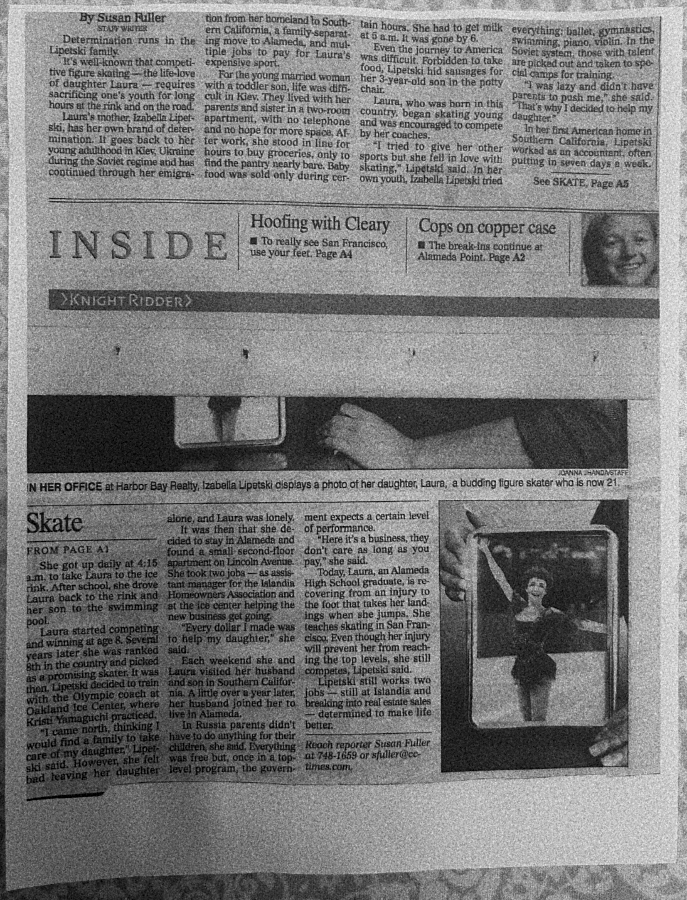
My mother moved first, with me, to a small second-floor apartment on Lincoln Avenue in Alameda. My father and brother stayed behind. Every weekend, my mother drove us down to visit them. It was over a year before my father could join us in the Bay Area.
In Alameda, she worked two jobs — one as an assistant manager at a homeowners association, the other at the ice center itself. She got up at 4:15 in the morning to take me to the rink. After school, she drove me back to the rink and my brother to swimming practice.
“Every dollar I made was to help my daughter,” she told the reporter.
I want to be careful about how I describe this next part, because I think it’s the most important thing in the whole story:
She Wasn’t a Martyr — She Was Strategic
There’s a moment in the article where my mother talks about the difference between the system she came from and the one she landed in. Back home, once a child was selected for a top-level program, the state handled everything — but it also expected a certain level of performance in return. In America, she said, “it’s a business. They don’t care as long as you pay.”
She understood that early. She didn’t expect anyone to make the path easier. She built the logistics, the income, the schedule, the housing — the whole infrastructure — herself, because she understood that this is how it works here.
That’s the part I think gets lost when people talk about “sacrifice.” Sacrifice without strategy burns parents out and resents kids. What my mother did was different: she clear-eyed assessed what the system required and built the life around it.
What I Take Into My Coaching
When parents come to me now — especially first-time skating parents — there are a few things I’m watching for, and they all come from my mother.
Did the child choose this?
My mother gave me ballet, gymnastics, swimming, piano, and violin before skating won. The skaters who go the furthest are usually the ones who chose the sport, not the ones the sport was chosen for.
Is the parent prepared for the logistics, not just the dream?
The dream is the easy part. The hard part is the 4:15 alarm, the second job, the year of weekend commutes, the apartment chosen for its proximity to a rink. I never ask a parent to do what my mother did — but I do ask them to be honest with themselves about what the real schedule will cost.
Is the parent investing in the child’s path, or their own unfinished one?
My mother told the reporter: “I was lazy and didn’t have parents to push me. That’s why I decided to help my daughter.” She was honest about her motivation. That kind of self-awareness is rare, and it’s worth a lot. Parents who can name why they’re doing this tend to make better decisions for their kids.
Is the family operating as a unit?
My family was physically separated for over a year so I could train. That’s not something I’d recommend or wish on anyone. But the principle behind it — that the whole family had aligned around the decision — is what made it workable. When skating becomes a wedge inside a family rather than a shared project, the skater is the one who pays for it.
On My Own Path
The article was written when I was 21 and recovering from a foot injury. I kept skating, kept competing, and eventually moved into coaching full time. Looking back, I don’t think any of it was wasted. Everything I learned as a skater — and everything I watched my mother learn as a skating parent — is what I bring to the rink every day.
I’ve been lucky over the years to work with skaters from the time they were small children all the way through serious competitive careers. Watching a young athlete grow up through this sport is one of the great privileges of this job. What I tell their parents is what I wish someone had told my mother — though she’d probably have figured it out anyway:
You don’t have to do everything. You just have to do the right things, consistently, for a very long time.
My mother did that. And the newspaper clipping she handed me a few weeks ago is the cleanest summary of it I’ve ever read.