Camel Spin Figure Skating: A Coach’s Guide to Position, Entry, and Balance
A camel spin in figure skating is performed on one foot with the free leg extended straight behind you at hip height or higher, torso leaning forward to form a long, T-shaped line. Correct technique depends on centering your weight over the ball of the skating foot, a straight free leg, and stable ‘airplane’ arms.
The camel spin figure skating students learn early on becomes the foundation for nearly every advanced spin variation they’ll do later — flying camels, camel-to-sit combinations, even some death drop entries. I’ve taught this spin to skaters from their very first wobbly attempts standing still on two feet all the way through junior-level competitive programs. It looks simple from the boards. It’s not. In this guide, I’ll walk through the position, the entry, how to find center, how skaters build up to it, and the fixes for the problems I see most often on my own rink.
What Is a Camel Spin in Figure Skating?
A camel spin is a one-foot spin where the free leg extends backward at or above hip level while the torso tilts forward, creating a long, elongated line often described as a ‘T’ shape or a spiral through the air. It’s one of the three basic spin positions in figure skating, alongside the upright spin and the sit spin.
You’ll see camel spins everywhere in a skater’s program — as standalone elements, inside spin combinations, and as the launching position for flying camel spins, where the skater jumps into the camel shape from forward motion. Once a skater has this position solid, it opens doors to a whole family of related spins.
Developmentally, the camel spin matters because it teaches something no upright spin can: balance with an offset center of mass. Your hips are tilted, your torso is horizontal-ish, and your weight has to stay precisely over one small point on the blade the entire time. That skill — core-driven control combined with precise edge and centering work — transfers directly into every advanced spin a skater will learn down the road.
I tell parents this spin isn’t a weekend project. It’s a skill I watch skaters build over months, sometimes longer, through steady repetition. That’s normal, and it’s not a sign anything is wrong.
What’s the Correct Camel Spin Position?
The correct camel spin position has three parts working together: a centered skating foot, a straight extended free leg at or above hip height, and a stable, forward-leaning upper body. If any one of these breaks down, the whole spin loses balance.
The Skating Foot — Edge, Placement, and Pressure
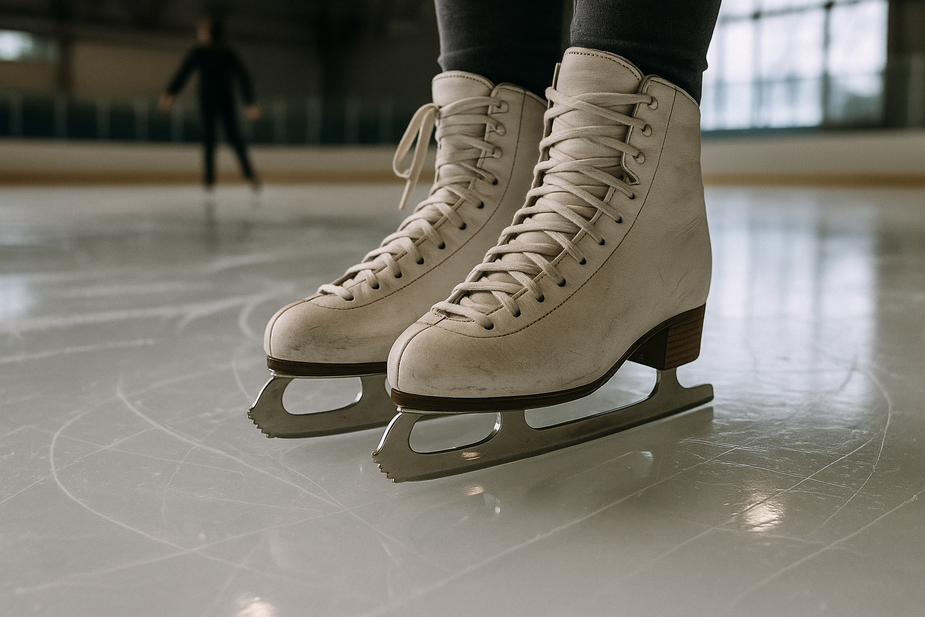
Everything starts with finding the ‘rocker’ of the blade — the balance point roughly under the ball of your foot. I have skaters feel for this spot before they ever try to spin on it.
Most camel spins enter on a back inside edge near the toe pick, then transition to a flatter part of the blade once the position centers. The skating knee stays slightly bent through entry and straightens as the spin stabilizes — it shouldn’t be locked stiff from the very first rotation.
The most common mistake I see is weight drifting toward the heel or getting stuck too deep on the toe pick. Both throw off the centering instantly. The fix is simple to say, harder to feel at first: consciously press pressure under the ball of the foot and check in with that spot every few rotations.
The Free Leg — Height, Extension, Alignment
The free leg extends straight behind the body, with the knee at or above hip height. I teach a flexed foot first — it’s much easier to keep the knee straight with a flexed foot than a pointed one, and a straight knee is the priority before we worry about a pretty toe point.
The leg needs to stay directly behind the body, not drifting out to the side, because any sideways drift tilts the rotational axis and throws the spin off balance. The toe points slightly outward to match natural hip turnout, but the pelvis shouldn’t drop or twist to accommodate it.
The mistake I correct most often here is a bent knee or a leg that sags below hip height. My go-to cue is ‘pull up the kneecap’ — it activates the right muscles without the skater overthinking the whole leg at once.
Upper Body Alignment — Posture, Shoulders, Arms, Head
I use an image I call the ‘magic table,’ set at belly-button height. The idea: your hands stay above that table line, your ribs rest gently on top of it, and your shoulders stay open and level across it.
During the spin itself, I cue ‘airplane arms’ — or with younger skaters, ‘cupcakes on your hands’ — arms extended out to the sides, palms turned slightly upward. The head stays aligned with the spine, eyes forward or toward the top of the boards, never tilted back or dropped toward the ice.
When arms drop below that table level, the whole body tends to collapse forward and the spin drifts off its spot. Watching for that table line is one of the fastest ways to self-correct mid-spin.
How Position Errors Affect Balance and Spin Quality
| Position Error | Effect on the Spin |
|---|---|
| Dropped arms or shoulders | Rocking, pulled off center |
| Free leg drifting sideways or bending | Traveling, loss of speed, falling out |
| Twisted shoulders (not square to rotation) | Imbalance, inconsistent edge |
| Weight on heel or deep toe pick | Wobbling, inability to hold position |
Once skaters know what each error feels like, they get much faster at fixing it themselves without waiting for me to call it out from the boards.
How Do You Do a Camel Spin? (Entry Techniques)
Most skaters learn the camel spin through a forward entry first, then progress to a backward entry once the forward version is consistently centered. Both rely on the same fundamentals: a clean edge, weight on the rocker, and a timed free leg lift.
The Forward Entry (Best for Beginners)
This is where I start almost every skater:
- Begin in a T-position — spinning foot in front, the matching arm reaching forward, the opposite arm reaching back.
- Step onto a forward outside edge with a slight knee bend, keeping the body leaning forward but shoulders held back, hands together above the magic table.
- Rotate through a three-turn to land on a back inside edge.
- Hold what I call the ‘ouch position’ — hips back, knee locked, hands up — for roughly three-quarters of a circle before doing anything else.
- Only then, open the arms fully out into the camel position.
For beginners, I simplify it to one cue: step in so everything is already set up, then just straighten your knee into position. Don’t rush to open the arms before the edge and body are actually ready.
The Backward Entry (After Forward Success)
Once a skater reliably centers a forward-entry camel, we introduce the backward entry. The fundamentals don’t change — clean edge, weight on the rocker, a well-timed free leg lift, and a stable core through the torso. This entry also serves as a bridge toward flying camel entries later on.
Building Momentum and Setting the Edge
Rotational momentum should come from a controlled turn of the upper body and arms around the skating foot — not from wild, flinging arm swings. Pressure through the lead arm and shoulder into the edge is what actually initiates clean rotation.
I like using a simple count with younger skaters: ‘1-2-3-step.’ It forces them to fully set the edge before adding any rotation, instead of rushing into the spin on an edge that isn’t ready.
Timing the Free Leg Lift
The free leg should lift as rotation begins — not before, and not after. Lift too early and the edge stalls out before the spin even starts. Lift too late and you get skidding or traveling across the ice.
Skaters should stay down on the entry knee until the toe pick engages through the three-turn, then straighten the skating leg as the free leg reaches full extension. I always emphasize a smooth ‘unfold’ into position rather than a jerky snap — the snap almost always throws the spin off center.
How Do You Find and Hold Center in a Camel Spin?
A centered camel spin feels like a steady pull toward the middle of the blade with no sideways sliding or wobble. Skaters know it the moment they feel it — the spin almost feels effortless once it locks in.
Signs of drifting off center are easy to spot from the boards: long loops or trace patterns on the ice instead of a tight circle, weight repeatedly shifting to the heel or toe, or the upper body swinging independently instead of rotating as one connected unit.
If you feel yourself drifting mid-spin, make small adjustments only. Re-center weight over the rocker, engage slightly through the core, make a minor realignment through the arms or torso. Big, sudden corrections almost always make things worse, not better.
The free leg plays a bigger role in centering than most skaters realize. Keeping it straight, directly behind the body, and at a consistent height stabilizes the entire rotational axis. If the leg wanders or bounces, the whole spin wanders and bounces with it.
Build up revolutions gradually. I’d much rather see a skater hold three clean, correctly positioned rotations than muscle through eight rotations in a collapsed shape. It’s worth knowing that even at the earliest competitive levels, U.S. Figure Skating requires the basic camel position to be held for multiple continuous revolutions for it to count — so correct shape and centering aren’t optional extras, they’re the requirement.
How Do Skaters Build Up to a Camel Spin? (Developmental Progression)
I treat the camel spin as a mid-level foundational skill — something learned after basic one-foot spins are solid, and before flying spins or spin combinations come into play. Skipping ahead usually just means more time spent fixing bad habits later.
Before I introduce a camel spin, I want to see:
- Solid two-foot and one-foot spins with clean centering and controlled exits
- Forward and backward spirals — especially back spirals, which mimic the camel body line closely
- Basic edge control on forward outside and back inside edges, including clean three-turns for entries
From there, I use a handful of drills consistently:
- Stationary two-foot camel hold — standing still, the skater assumes the full camel shape (torso forward, free leg extended) purely to learn alignment before any rotation is involved.
- Wall drills — practicing the camel line at the boards, checking hip placement, level shoulders, torso parallel to the ice, and toe pointed outward without a coach having to say anything.
- Back spiral exercises — full-ice or half-ice back spirals to rehearse the camel body line and core control while gliding, without the added complexity of rotation.
- Entry pattern holds — holding the ‘ouch position’ for most of a circle before opening the arms into airplane position, so the entry becomes automatic before we ever add speed.
I also have skaters practice entries completely separate from the spin itself — repeating the entry edge and arm/torso setup, then stepping out instead of spinning, just to check that the balance point is right before we combine everything.
Variations only come once a skater has a consistent, centered basic camel: speed changes, arm variations, changing feet or edges, and camel-to-sit transitions. Adding variety too early just compounds whatever’s already unstable in the basic shape.
Why Does My Camel Spin Travel or Fall Out? (Troubleshooting)
Most camel spin problems trace back to one of four things: dropped upper body position, an unset edge, free leg misalignment, or rushing the entry. Here’s how I break it down with skaters at the rink.
Losing Balance or Falling Out
This usually comes from dropped arms or twisted shoulders, weight sitting on the heel or too deep on the toe pick, or a sudden, uncontrolled change in the free leg. I go back to the ‘magic table’ cue, slow the entry way down so the skater can feel centered weight before adding speed, and use stationary two-foot holds to rebuild the shape from scratch if needed.
Can’t Hold the Free Leg High Enough
Often the knee isn’t fully straight, or the hip alignment is off and the leg is drifting sideways instead of staying directly behind the body. Back spiral drills help enormously here, along with the ‘pull up the kneecap’ cue. I have skaters raise the leg gradually toward hip height and beyond rather than forcing it all at once.
Traveling Across the Ice Instead of Spinning in Place
This is almost always an edge problem — the blade rocking between inside and outside, or heel and toe, instead of staying set on the rocker. Independent arm or free leg movement (not connected to the torso) makes it worse. The fix: step onto the rocker and stay there, cut down on arm swing, use neutral airplane arms, and slow the entry counts down until the edge is dependable.
Difficulty Centering or Holding the Position Steady
This tends to come from inconsistent core engagement or a rushed entry that wasn’t held long enough before opening into the spin. Slowing the entry down and holding the pre-spin position longer usually solves it. Once spinning, small mid-spin corrections work far better than big compensating movements.
How to Diagnose Which Part Is the Problem
When something’s off and it’s not obvious why, I isolate variables one at a time. Run just the entry pattern with no spin at all. Run just the back spiral shape on its own. Run the camel position from a slow walk-in with no power behind it.
Trace marks left in the ice tell an honest story, and combined with careful coach observation, they usually reveal pretty quickly whether the real issue is blade placement, the free leg, or the upper body. I’ve spent a good part of my coaching career here in the Bay Area helping skaters work through exactly this kind of troubleshooting, one small adjustment at a time.
Frequently Asked Questions
How long does it take to learn a camel spin?
Timelines vary, but most skaters move through stages: mastering basic spins and spirals, learning the position on two feet, then combining entry with rotation. This can take anywhere from several weeks to a few months of consistent practice.
What’s the difference between a camel spin and a sit spin?
A camel spin has the torso leaning forward with the free leg extended behind at hip height or higher, forming a long line. A sit spin lowers the hips with the skating knee bent near a right angle and the free leg extended forward — a much more upright-to-seated shape.
Can very young skaters do a camel spin?
Yes, but it’s typically introduced after a skater has solid control of basic one-foot spins and edge skills. Coaches sequence spirals and simpler spins first to build the balance and control the camel position requires.
Why does my camel spin travel instead of staying in one spot?
Traveling usually comes from the blade not staying centered over the rocker, or from arms and the free leg swinging independently of the torso. Checking your entry edge and keeping stable airplane arms typically resolves it.
How do I know if my camel spin position is high enough?
A clear camel shows the free leg at or above hip height, forming a horizontal line, with the torso leaning forward to balance it. Reviewing video is one of the best ways to confirm the leg isn’t drooping below that line.
Camel spins take patience, and they take repetition — a lot more of it than most new skaters expect. But I’ve watched enough skaters work through this exact progression to know that the steady, unglamorous work of fixing edge placement, free leg height, and arm position now pays off in every single spin variation they’ll learn later. Keep showing up, keep checking the small details, and trust the process.